Why “How many minutes?” is the wrong first question
Minutes describe time, but they do not describe how much optical energy reaches the skin. Ten minutes in front of a low-output device at 30 cm can be very different from ten minutes near a higher-output panel. The relevant starting variables are irradiance, distance, mode, beam pattern, exposed area, and time.
The simplified surface-dose equation is:
Fluence (J/cm²) = irradiance (mW/cm²) × time (seconds) ÷ 1,000.
This calculation still does not tell you exactly how much light reaches a deeper target, but it makes protocols more comparable than session duration alone.
What skin studies actually did
In the 2007 split-face skin-rejuvenation trial, active light or sham treatment was delivered twice weekly for four weeks.[2] The 2023 periocular wrinkle study used 10 sessions over four weeks, with a reported dose of 3.8 J/cm² per session in the published abstract.[3]
A larger controlled study of 136 volunteers used two sessions per week and assessed outcomes after 30 sessions. It reported improvements in skin roughness and ultrasound-derived collagen density in active groups compared with controls.[4]
These studies do not establish that daily facial treatment is necessary. They show that repeated, moderate schedules can be studied successfully.
What hair-growth studies did
Hair trials generally run much longer. A multicentre sham-controlled study treated the scalp three times weekly for 26 weeks.[5] A 24-week split-scalp trial used three 30-minute sessions per week.[6] A 16-week helmet study also evaluated repeated use over months rather than days.[7]
That timeline reflects the biology being measured. Hair cycles are slow; an immediate subjective sensation is not a substitute for standardized hair counts.
What sports studies did
Sports protocols can be acute rather than cumulative. In a 2024 crossover study, runners received one of several total-energy doses 60 minutes before a 5 km test. None of the active doses improved running time or perceived exertion compared with placebo.[8]
Other exercise trials apply light before repeated training sessions or before a muscle-damaging exercise bout. These studies investigate a different question from long-term skin or hair use and cannot determine a general weekly home routine.
Can red light therapy be used every day?
Some consumer devices are designed for frequent use, but “safe to use daily” and “daily is more effective” are not the same statement. Human evidence does not support a universal rule that more frequent exposure always accelerates results.
Primary laboratory studies show biphasic responses: lower doses can stimulate cellular activity, while larger doses can flatten or reverse the response. In human skin fibroblasts, lower 660 nm doses increased mitochondrial activity and cell viability, while larger tested doses reduced activity.[9]
Because those are laboratory findings, they cannot prescribe a consumer schedule. They do, however, support a conservative principle: do not automatically double session time or frequency to chase faster results.
A practical way to build a repeatable routine
- Use the product-specific manual. Do not substitute a protocol from another brand or study.
- Keep distance fixed. Mark the floor or mounting position if necessary.
- Keep mode fixed. Red-only and combined red/NIR modes can deliver different output.
- Start at the lower end of the recommended range. Increase only if the product instructions allow it and the session is well tolerated.
- Do not stack missed sessions. Consistency is more useful than occasional very long exposure.
- Track the same outcome in the same way. Use standardized photographs, a repeated performance measure, or another relevant metric.
- Review after an outcome-appropriate interval. Skin and hair should not be judged after a handful of sessions.
How long before results appear?
| Goal | What research timelines suggest | Important caution |
|---|---|---|
| Wrinkles and skin texture | Often measured after 4–15 weeks of repeated sessions | Changes may be modest and endpoint-specific |
| Pattern hair loss | Commonly assessed after 16–26 weeks | Only certain hair-loss types and scalp devices were studied |
| Exercise performance | Can be assessed immediately or across a training block | Results are mixed and protocol-specific |
| General wellness | No single validated timeline | Subjective changes are vulnerable to expectation and lifestyle confounding |
When to reduce or stop
Stop and seek appropriate advice if a session causes persistent redness, blistering, worsening symptoms, visual disturbance, severe headache, unexpected skin pigmentation, or another concerning reaction. Extra caution is appropriate for people with photosensitivity, light-triggered seizures or migraines, eye disease, suspicious skin lesions, or medications that increase light sensitivity.
How to compare a HealPRO routine with a study
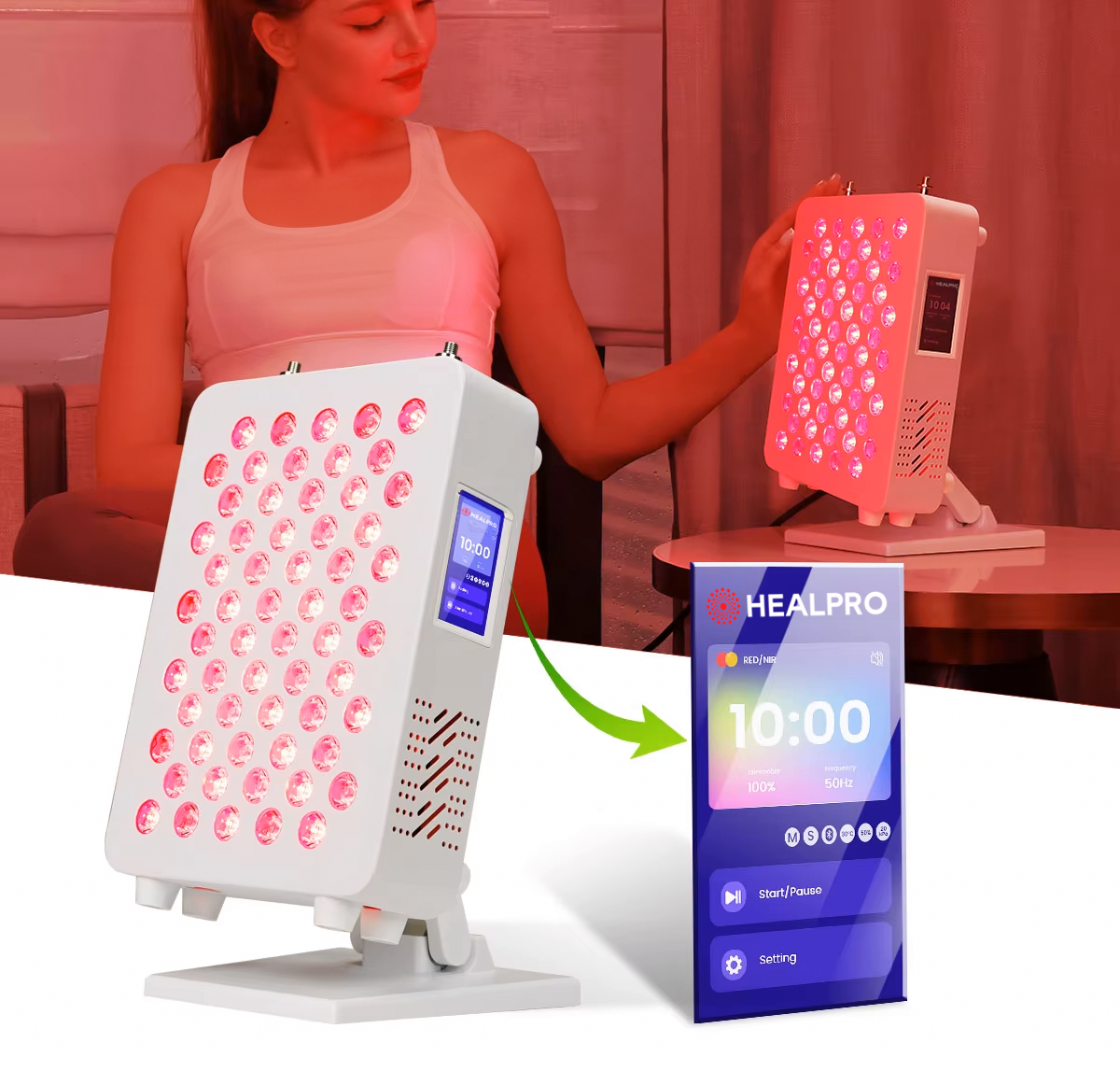
Record the panel model, selected wavelengths, brightness, distance, session duration, weekly frequency, treatment area, and the outcome you are tracking. Then compare those fields with the study protocol. Similar wavelength alone is not enough.
See HealPRO’s product-testing methodology and the Focus, Core and Aura comparison for the device-specific information needed to estimate a routine.
Frequently asked questions
Is 20 minutes better than 10 minutes?
Not necessarily. If irradiance is doubled, the same time delivers twice the nominal surface dose. If distance increases, irradiance may fall. Session time must be interpreted with the actual measured output.
Can I use red light therapy twice a day?
There is no universal evidence-based reason to do so. Use the device-specific instructions and avoid increasing exposure solely because one session was missed or because results are gradual.
Should I use red light therapy before or after exercise?
Both timings have been studied, but results vary. A protocol designed for skin or hair cannot answer a sports-recovery timing question.
When should I take progress photos?
Take a baseline image before starting, then repeat with the same lighting, lens, distance, expression, and time of day. For skin, monthly comparison is usually more informative than daily inspection.
References
- GummySearch. r/redlighttherapy community analysis. Accessed 19 July 2026.
- Lee SY, et al. Randomized placebo-controlled split-face LED phototherapy study. 2007.
- Mota LR, et al. Photobiomodulation Reduces Periocular Wrinkle Volume by 30%. 2023.
- Wunsch A, Matuschka K. Controlled trial of red and near-infrared light for fine lines, wrinkles, roughness, and collagen density. 2014.
- Jimenez JJ, et al. Multicenter randomized sham-controlled low-level laser trials for male and female pattern hair loss. 2014.
- Randomized double-blind split-scalp sham-controlled low-level light trial for androgenetic alopecia. 2018.
- Helmet-type low-level light therapy for androgenetic alopecia: 16-week randomized double-blind sham-controlled trial. 2020.
- Acute PBM dose-response on 5-km running performance: randomized double-blind placebo-controlled crossover study. 2024.
- Biphasic Dose/Response of Photobiomodulation Therapy on Culture of Human Fibroblasts. 2020.
How this article was prepared
The question was selected from recurring discussion clusters in r/redlighttherapy. Reddit discussions were used to identify what people want answered, not as proof of effectiveness. Scientific conclusions were based on the cited human trials and supporting primary research. Commercial links are separated from the evidence discussion.