Start with the diagnosis, not the device
“Hair loss” is not one condition. Pattern hair loss, telogen effluvium, alopecia areata, traction alopecia, scarring alopecia, nutritional deficiency, thyroid disease, medication effects, postpartum shedding, and scalp inflammation have different causes and treatment priorities.
The strongest red-light evidence discussed here concerns androgenetic alopecia, also called male- or female-pattern hair loss. Sudden, patchy, painful, scarred, or rapidly progressive hair loss requires professional assessment rather than experimentation with a light device.
The 2009 laser-comb trial
A multicentre randomized, double-blind, sham-device-controlled trial evaluated a 655 nm HairMax LaserComb in men with androgenetic alopecia. Of the 110 participants who completed the 26-week study, the active-device group had a significantly greater increase in terminal hair density than the sham group. The device was generally well tolerated, with no serious adverse events reported.[2]
The comb design deliberately parted the hair so light could reach the scalp. That detail matters when comparing the study with a panel positioned outside dense hair.
The multicentre male and female trials
Jimenez and colleagues conducted randomized, sham-controlled, double-blind trials in men and women with pattern hair loss. Participants used one of several laser-comb models or a sham device across the whole scalp three times weekly for 26 weeks. The active-device groups showed significantly greater terminal hair density than the sham groups.[3]
The value of this study is not merely that “red light grew hair.” It tested a defined device, scalp geometry, schedule, and diagnosis.
The 24-week split-scalp trial
A randomized, double-blind, self-comparison study enrolled 100 people with androgenetic alopecia. One side of each participant’s scalp received active treatment and the other received sham light three times weekly for 30 minutes over 24 weeks. The active side had significantly greater improvements in hair coverage, thickness, count, and investigator assessment at 12 and 24 weeks.[4]
Because each participant served as their own control, the design helps reduce variability between people. It still does not establish that a different light source or dose will perform identically.
The 16-week helmet trial
A multicentre randomized double-blind sham-controlled trial enrolled 60 participants aged 19–65. A 655 nm helmet-type device was used for 16 weeks. The active group showed a larger increase in hair density and thickness than the sham group.[5]
This trial suggests that a hands-free helmet can be effective under a specific protocol, but it also reinforces the importance of keeping the light close to and evenly distributed over the scalp.
Not every combination produces a clear additional benefit
A 2023 randomized trial compared low-level light therapy plus topical 5% minoxidil with minoxidil alone for 16 weeks. Hair density improved in both groups, but the difference between groups was not statistically significant.[6]
This is a useful counterweight to the assumption that adding light to an established treatment must always improve the result.
How large were the reported effects?
Effect sizes differ because studies count hairs in different target areas, use different devices, and report absolute counts, percentages, coverage, diameter, or investigator scores. Trials in men and women using 655 nm laser and LED sources reported significantly greater hair-count increases than placebo, but those percentages should not be converted into a guaranteed personal outcome.[7][8]
Why hair blocks light
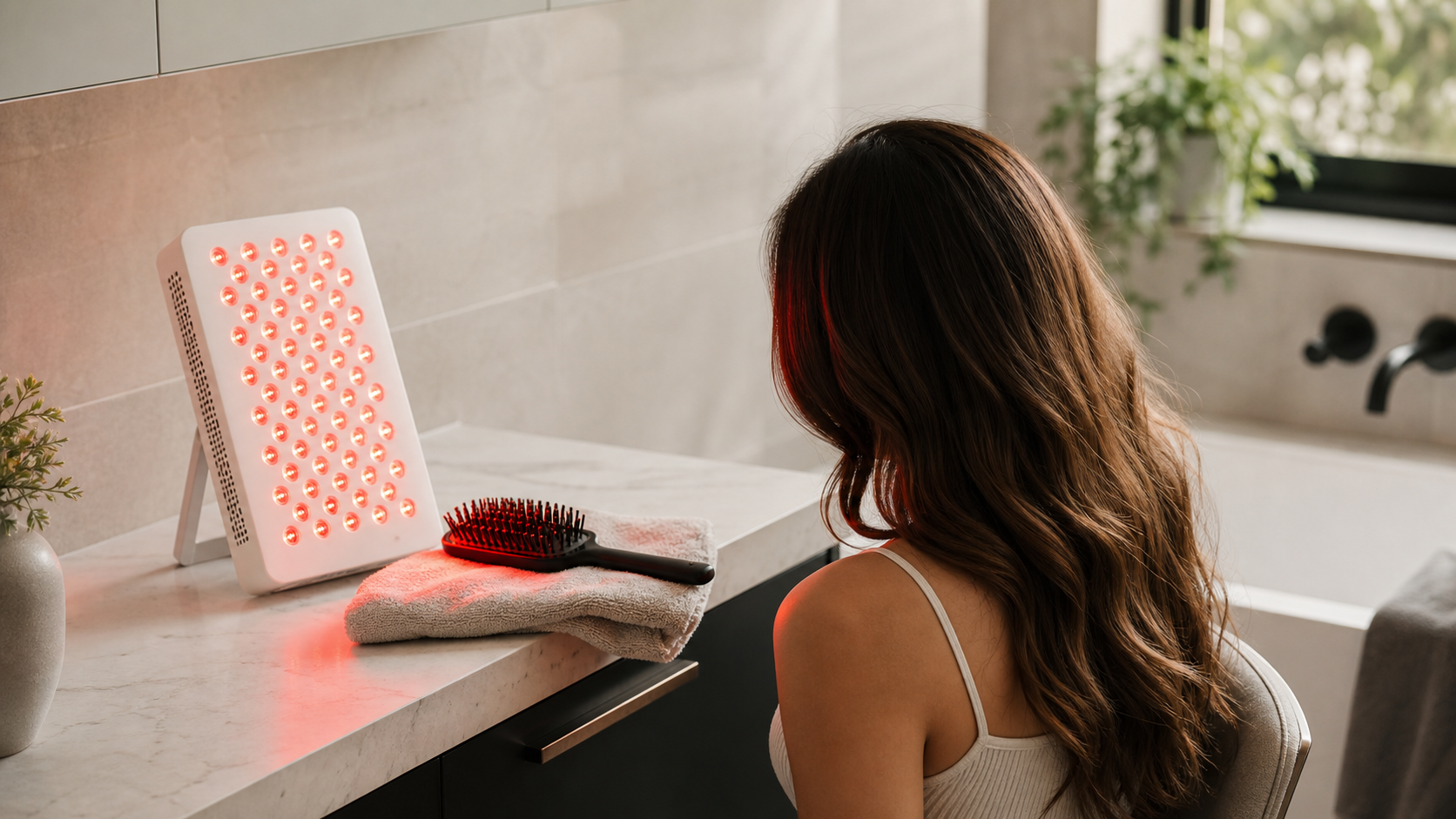
Hair can shadow the scalp. A comb separates hair, and a helmet places emitters close to the scalp from multiple directions. A free-standing panel can illuminate a larger region, but the effective scalp dose may be reduced by hair density, angle, distance, and movement.
For a panel-based routine, record:
- distance from panel to scalp;
- head angle and area exposed;
- whether hair is parted;
- session time;
- weekly frequency;
- selected wavelengths;
- measured output at the scalp position.
A panel should not be described as equivalent to a studied helmet or comb unless that equivalence has been tested.
How long should hair treatment take?
Most positive randomized trials assessed outcomes after 16–26 weeks, usually with treatment around three times per week. Hair biology is slow, and photographs taken after two or three weeks are unlikely to provide a reliable answer.
Long-term maintenance is less clearly standardized. If treatment is stopped, any benefit may not be permanent because androgenetic alopecia remains an ongoing condition.
Who should be cautious?
Seek medical assessment before self-treatment if hair loss is sudden, patchy, inflamed, scarred, painful, associated with systemic symptoms, or accompanied by changes in nails or skin. Also discuss light exposure with a clinician if you have photosensitivity, take photosensitizing medication, have a history of light-triggered seizures or migraine, or are treating a suspicious scalp lesion.
How to track results properly
- Photograph the same marked scalp area before starting.
- Use the same camera, lens, distance, hairstyle, wetness, and lighting.
- Repeat no more often than monthly.
- Track shedding separately from density.
- Do not change several treatments at once if you want to know what affected the result.
- Use professional trichoscopy or standardized hair counts where possible.
Bottom line
There is credible human evidence that specific low-level red-light devices can improve hair-density measures in androgenetic alopecia. The evidence is strongest for scalp-specific combs and helmets used consistently for several months. It is not evidence that any red panel treats every kind of hair loss.
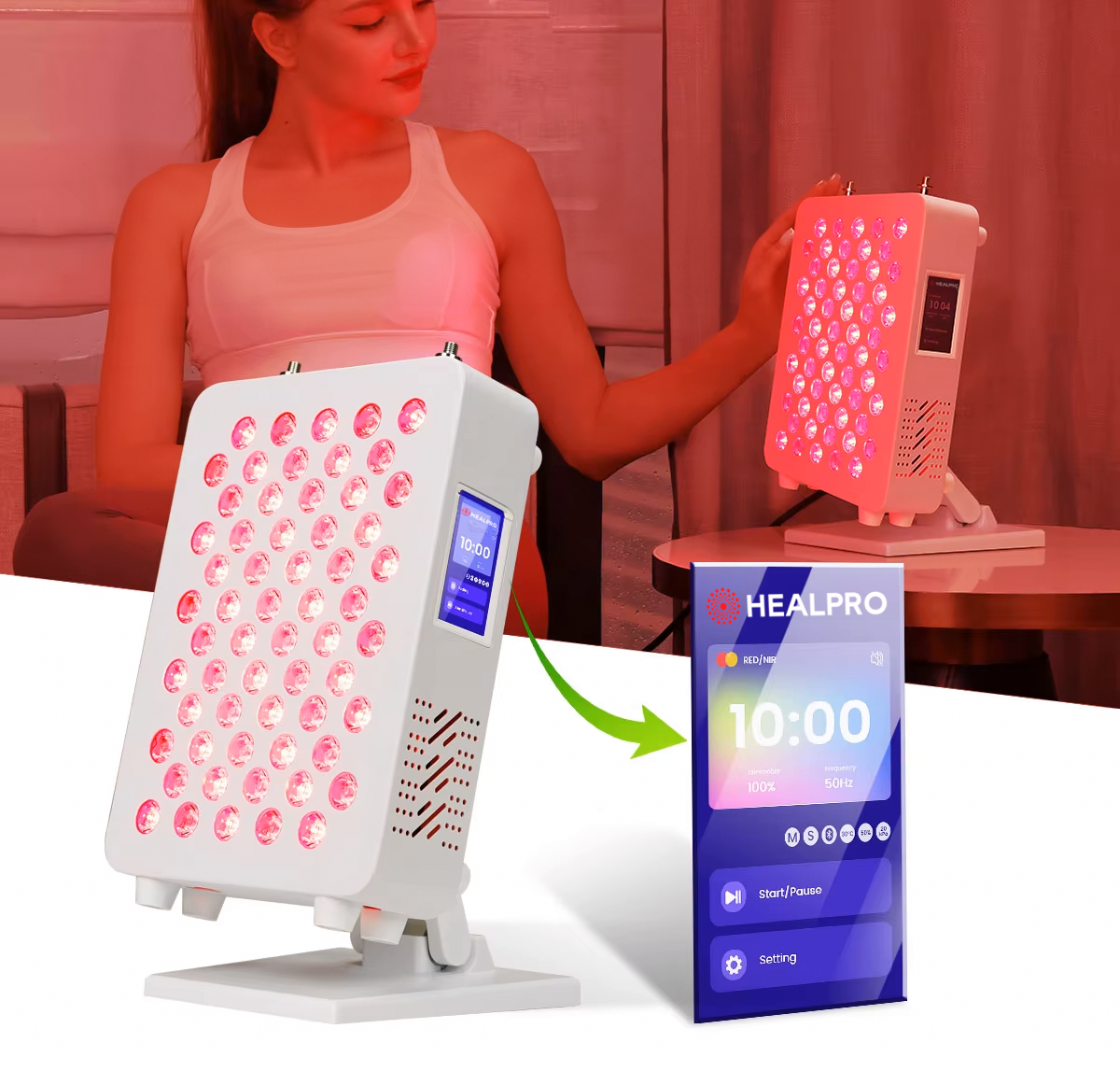
For broader home use, compare the HealPRO panel range and read the measurement methodology, while preserving a clear distinction between panel specifications and the scalp-device protocols used in hair trials.
Frequently asked questions
Which wavelength is used for hair growth?
Many randomized scalp-device trials used red light near 655 nm. That does not establish one universally optimal wavelength or dose.
How many times per week?
Several major trials used three sessions per week for 24–26 weeks. Follow the instructions for the specific device rather than copying a protocol from a different product.
Can a body panel grow hair?
A panel can expose the scalp to red or near-infrared light, but the best human evidence is from scalp-specific combs and helmets. Hair obstruction, distance, and geometry make direct equivalence uncertain.
Can red light replace minoxidil or finasteride?
The studies do not establish universal replacement. Treatment choice depends on diagnosis, contraindications, preferences, and clinician advice.
References
- GummySearch. r/redlighttherapy community analysis. Accessed 19 July 2026.
- Leavitt M, et al. HairMax LaserComb in male androgenetic alopecia: randomized double-blind sham-device-controlled multicentre trial. 2009.
- Jimenez JJ, et al. Low-level laser device in male and female pattern hair loss: multicentre randomized sham-controlled double-blind study. 2014.
- Efficacy and Safety of Low-Level Light Therapy for Androgenetic Alopecia: 24-week randomized double-blind split-scalp sham-controlled trial. 2018.
- Helmet-type low-level light therapy for androgenetic alopecia: 16-week multicentre randomized double-blind sham-controlled trial. 2020.
- Low-level laser therapy plus minoxidil versus minoxidil alone in androgenetic alopecia: randomized controlled trial. 2023.
- Lanzafame RJ, et al. Growth of human scalp hair mediated by visible red laser and LED sources in males. 2013.
- Growth of human scalp hair in females using visible red laser and LED sources. 2014.
How this article was prepared
The question was selected from recurring discussion clusters in r/redlighttherapy. Reddit discussions were used to identify what people want answered, not as proof of effectiveness. Scientific conclusions were based on the cited human trials and supporting primary research. Commercial links are separated from the evidence discussion.