What does “better skin” actually mean?
Marketing often compresses several different outcomes into one promise. Researchers may measure:
- wrinkle volume or depth;
- surface roughness;
- elasticity;
- hydration;
- viscoelasticity;
- ultrasound-derived dermal or collagen density;
- histologic collagen and elastic fibres;
- participant satisfaction.
An intervention can improve one endpoint and leave another unchanged. That is exactly what happened in the 2023 Mota trial.
The strongest sham-controlled skin study
Lee and colleagues enrolled 76 participants with facial wrinkles in a randomized, placebo-controlled, double-blinded split-face study. The right half of the face received 830 nm, 633 nm, a combination, or sham treatment twice weekly for four weeks. The researchers used photography, profilometry, elasticity measurements, histology, electron microscopy, immunohistochemistry, and gene-expression testing.
The active groups showed objective wrinkle reductions and elasticity increases compared with baseline, with maximum reported changes of 36% and 19% respectively. Histology showed increased collagen and elastic fibres, and ultrastructural examination showed activated fibroblasts surrounded by collagen and elastic fibres.[2]
Strengths include the sham group, blinded assessment, split-face design, and multiple objective measures. Limitations include a relatively short treatment period and the challenge of applying one clinical device protocol to consumer panels.
The 2014 collagen-density study
Wunsch and Matuschka studied 136 volunteers in a prospective randomized controlled trial. Active groups received polychromatic red or red-to-near-infrared light twice weekly and were compared with controls. Outcomes were assessed after 30 sessions using blinded photography, computerized profilometry, participant satisfaction, and ultrasound-derived collagen density.
The active groups reported improvements in complexion, skin feeling, roughness, and measured collagen density compared with controls. The broader polychromatic spectrum did not show an advantage over the red-light-only spectrum.[3]
This study measured a collagen-density proxy using ultrasound; it was not a direct comparison with microneedling, radiofrequency, or laser resurfacing.
The 2023 wrinkle-volume trial
Mota and colleagues recruited 137 women aged 40–65 in a randomized split-face trial. One side received 660 nm red light and the other 590 nm amber light. Participants completed 10 sessions over four weeks. The published abstract reports a dose of 3.8 J/cm² per session.[4]
Wrinkle volume decreased by 31.6% after red light and 29.9% after amber light. Hydration and viscoelasticity did not improve. Because both sides received an active wavelength, the study does not show how either treatment compared with a sham or untreated face.
An important public-record discrepancy
The public Brazilian trial registry describes a planned 14-minute session at 5.4 J/cm², while the published abstract reports 3.8 J/cm². The public records do not explain that difference.[5]
This does not erase the published result, but it limits how confidently a consumer can reproduce the protocol. A high-quality evidence article should preserve that uncertainty rather than silently selecting one dose.
What about older combination-LED studies?
Earlier clinical studies used combinations such as 633 nm and 830 nm. Russell and colleagues reported improvements in facial skin rejuvenation with combination LED treatment, and Goldberg and colleagues examined combined 633 nm and 830 nm treatment of photoaged skin.[6][7] These studies contribute to the broader evidence base but vary in design quality, device, protocol, and outcome measurement.
What the evidence supports
- Some red and near-infrared protocols can alter objective wrinkle or skin-surface measurements.
- Some studies report increased histologic collagen fibres or ultrasound-derived collagen density.
- Changes are usually measured over weeks or months, not after one session.
- Different skin properties do not necessarily improve together.
- Results depend on the exact protocol and cannot be assigned to any device with similar-coloured LEDs.
What the evidence does not support
- That red light is superior to microneedling for collagen production.
- That every consumer panel will reduce wrinkles by 30%.
- That more wavelengths or higher irradiance produce better skin outcomes.
- That the Mota trial directly measured collagen synthesis.
- That a change in wrinkle volume proves improved hydration or elasticity.
- That red light replaces sunscreen, medical treatment, or established skin-care interventions.
How to compare a home panel with a skin study
Record and compare:
- wavelengths;
- irradiance at the actual face-to-panel distance;
- fluence per session;
- session duration;
- weekly frequency;
- total number of sessions;
- distance and beam geometry;
- skin area treated;
- the study’s exact outcome measure.
Even a close match does not guarantee the same result, but it is more credible than relying on wavelength alone.
Bottom line
The human evidence for wrinkles and collagen-related outcomes is promising but protocol-specific. The most defensible claim is that several controlled trials have reported measurable changes in wrinkles, roughness, elasticity, histology, or ultrasound-derived collagen density. The evidence does not justify promising a fixed percentage improvement from a particular home panel without direct product testing.
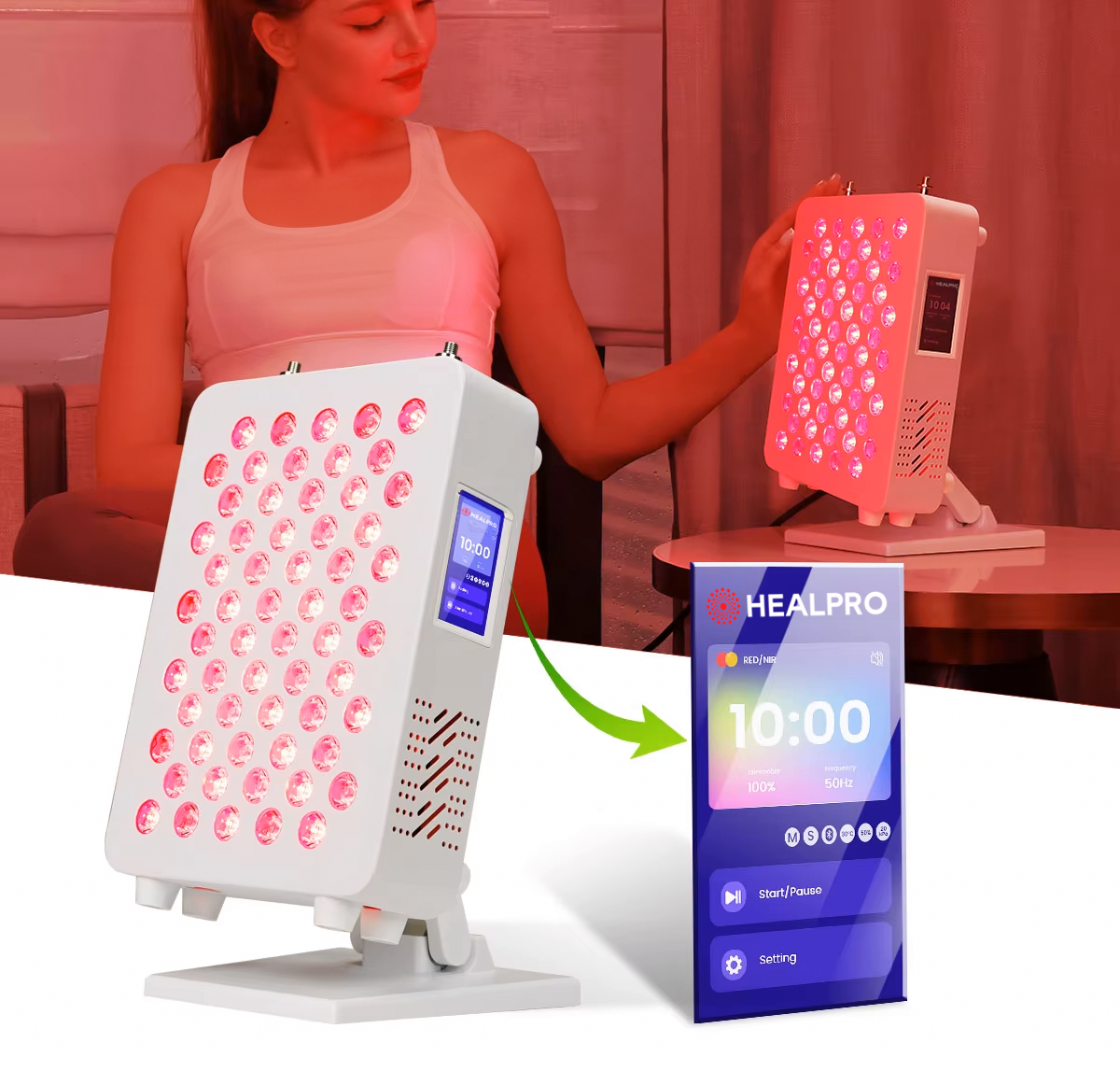
Explore the HealPRO panel range and read how output is measured before comparing a study protocol with a consumer device.
Frequently asked questions
Does red light therapy create new collagen?
Some human studies report histologic increases in collagen fibres or higher ultrasound-derived collagen density. These findings support a collagen-related effect under the tested conditions, but they do not quantify the same biological process in every study.
How long does red light therapy take to affect wrinkles?
Key trials assessed results after approximately four weeks to several months. Visible change is usually gradual and may be subtle.
Is red light better than microneedling?
The studies discussed here do not provide a direct head-to-head comparison that establishes superiority for collagen production or wrinkle improvement.
Can I use a full-body panel on my face?
A panel can illuminate the face, but the relevant questions are distance, irradiance, dose, uniformity, eye guidance, and whether the protocol resembles one that has been studied.
References
- GummySearch. r/redlighttherapy community analysis. Accessed 19 July 2026.
- Lee SY, et al. Prospective randomized placebo-controlled double-blinded split-face LED phototherapy study. J Photochem Photobiol B. 2007.
- Wunsch A, Matuschka K. Controlled trial of red and near-infrared light for fine lines, wrinkles, roughness, and collagen density. Photomed Laser Surg. 2014.
- Mota LR, et al. Photobiomodulation Reduces Periocular Wrinkle Volume by 30%: A Randomized Controlled Trial. 2023.
- Brazilian Clinical Trials Registry RBR-6yfcbm.
- Russell BA, Kellett N, Reilly LR. Combination LED light therapy at 633 nm and 830 nm in facial skin rejuvenation. 2005.
- Goldberg DJ, et al. Combined 633-nm and 830-nm LED treatment of photoaging skin. 2006.
How this article was prepared
The question was selected from recurring discussion clusters in r/redlighttherapy. Reddit discussions were used to identify what people want answered, not as proof of effectiveness. Scientific conclusions were based on the cited human trials and supporting primary research. Commercial links are separated from the evidence discussion.