Why this is one of Reddit's biggest red light therapy questions
Current r/redlighttherapy topic analysis shows that proof, effectiveness, purchasing confusion, skin results, and hair growth dominate the community's recurring discussions. The question is often framed as: “Does red light therapy actually work, or is it an expensive placebo?” That framing is understandable, but scientifically it is too broad. “Red light therapy” can describe a facial LED device, a scalp laser comb, a full-body panel, an LED cluster used before exercise, or a clinical device used next to a wound. Those are not interchangeable interventions.
What would count as convincing evidence?
The strongest practical evidence usually comes from randomized trials with a credible sham device, objective outcome measurements, enough participants, a pre-specified protocol, and transparent reporting. A before-and-after photograph without a control group is much weaker because lighting, camera distance, hydration, skincare, natural fluctuation, and expectation can all influence the apparent result.
It is also important to separate a statistically significant result from a large or meaningful result. A study can detect a measurable difference without proving that every user will notice a major change. Conversely, a small study can miss a real effect because it lacks statistical power.
Evidence for facial wrinkles and skin rejuvenation
A 2007 randomized, placebo-controlled, double-blinded split-face study included 76 participants with facial wrinkles. Participants received 633 nm red light, 830 nm near-infrared light, a combination, or sham treatment twice weekly for four weeks. The investigators reported objective reductions in wrinkles and increases in elasticity in the active groups, together with histologic and ultrastructural changes involving collagen and elastic fibres.[2]
A 2023 split-face randomized trial recruited 137 women aged 40–65. Each participant received red light at 660 nm on one side and amber light at 590 nm on the other side for 10 sessions across four weeks. Periocular wrinkle volume decreased by 31.6% on the red-light side and 29.9% on the amber-light side. Hydration and viscoelasticity did not improve, which is a useful reminder that one positive endpoint does not mean every skin property changed.[3]
These studies support the proposition that certain light protocols can affect measured skin-ageing outcomes. They do not establish that every panel, mask, wavelength combination, session length, or home routine will reproduce the same result.
Evidence for hair growth
Several sham-device-controlled trials have reported improvements in terminal hair density for androgenetic, or pattern, hair loss. A multicentre study in men and women evaluated laser-comb devices used three times weekly for 26 weeks and reported significantly greater terminal hair density with active devices than with sham devices.[4] A separate 24-week split-scalp trial in 100 participants also reported significantly better hair coverage and several hair-growth measures on the active-treated side.[5]
However, these results apply to pattern hair loss and to scalp-specific devices and schedules. They should not be generalized to sudden shedding, scarring alopecia, alopecia areata, nutritional deficiency, thyroid disease, postpartum shedding, or any undiagnosed hair-loss condition.
Evidence for exercise performance and recovery is mixed
Sports studies demonstrate why blanket claims are unreliable. In one randomized study of 28 men performing plyometric exercise, 630 nm and 940 nm LED protocols influenced selected creatine kinase and jump-performance outcomes, but did not improve every measure; delayed-onset soreness and countermovement jump were not significantly different after the first bout.[6]
In contrast, a 2024 randomized, double-blind, placebo-controlled crossover study gave trained runners 300, 900, or 1260 joules of red and infrared LED treatment before a 5 km trial. Running time, mean velocity, and perceived exertion were similar across active and placebo conditions. The authors did not recommend the tested acute protocols for improving 5 km performance.[7]
Another six-week exercise trial in trained participants found no additional benefit from adding photobiomodulation to training compared with placebo or no additional intervention.[8]
Why one person can see results while another sees none
- The target is different. Fine lines, hair follicles, muscle soreness, wound healing, and running performance are different biological problems.
- The delivered dose is different. Minutes alone do not describe exposure. Irradiance, time, distance, beam angle, coverage, and tissue geometry all matter.
- The wavelength is different. Studies use red, amber, and near-infrared wavelengths alone or in combinations.
- The timing is different. Some protocols treat before exercise, others after exercise, and others several times weekly for months.
- The comparison is different. A change from baseline can look impressive but may be less convincing than a difference from a sham device.
- The outcome is different. Subjective satisfaction, photographs, histology, ultrasound, hair counts, soreness scales, and timed performance tests are not equivalent.
Is a placebo effect still possible?
Yes. Subjective outcomes such as pain, energy, sleep quality, recovery, and appearance are especially vulnerable to expectation, attention, routine changes, and confirmation bias. That is why sham-controlled trials matter. At the same time, objective findings such as hair counts, wrinkle profilometry, histology, or measured running time are less easily explained by expectation alone, although they can still be affected by study design and measurement error.
What safety studies add to the picture
Red light is often described as low risk, but dose still matters. Two randomized dose-escalation trials exposed healthy skin to unusually high red-light fluences of 160–640 J/cm². Most adverse events were mild and transient, but blistering or prolonged erythema occurred at the highest dose levels in a small number of participants. Those experiments were far above many ordinary home protocols, but they demonstrate that “non-UV” does not mean dose is irrelevant.[9]
How to assess any red light therapy claim
- Identify the exact outcome being claimed.
- Ask whether the evidence is from humans, animals, cell culture, or theory.
- Check whether the trial used a sham device.
- Compare wavelength, dose, distance, schedule, and treatment area with the product being sold.
- Look for absolute results, not only percentages.
- Check negative and neutral endpoints, not only the most favourable result.
- Look for funding and conflict-of-interest disclosures.
- Do not assume a study of one device establishes performance for another.
Bottom line
Red light therapy is neither a universal cure nor automatically a placebo. It is a family of light-based protocols with outcome-specific evidence. The strongest consumer position is to expect modest, gradual, protocol-dependent effects rather than dramatic changes across every health and beauty goal.
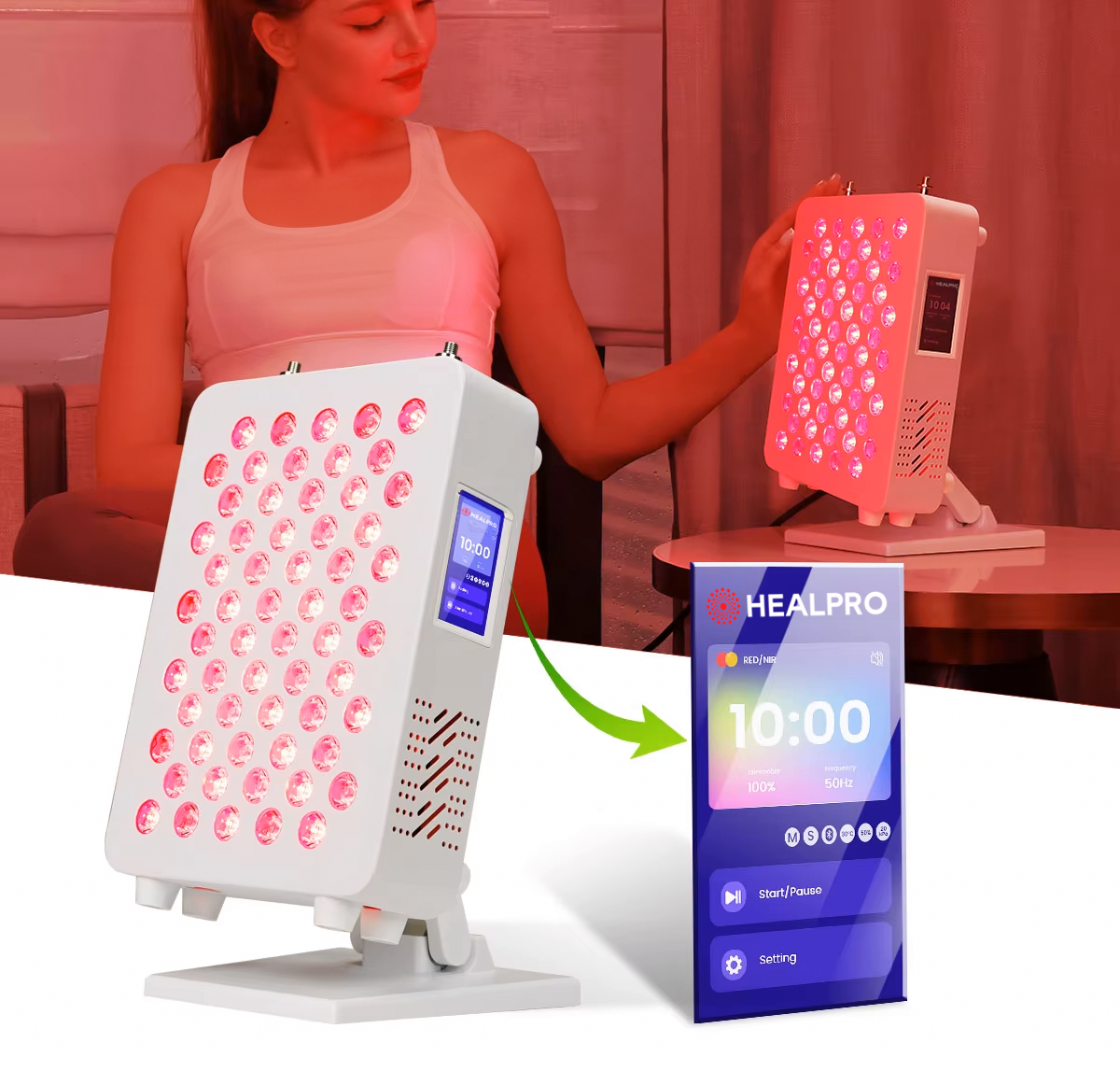
Before purchasing, compare measurable product information in the HealPRO red light therapy panel range, use the Focus, Core and Aura comparison, and read the product-testing methodology.
Frequently asked questions
How quickly should red light therapy work?
There is no universal timeline. Some skin trials ran for four weeks, while hair-growth trials commonly lasted 16–26 weeks. A rapid sensation of warmth or relaxation is not the same as a measured biological outcome.
Does red light therapy work for everyone?
No. Trials report group averages, and individual response varies. Device specifications, dose, adherence, baseline condition, age, tissue thickness, concurrent treatments, and measurement method can all affect results.
Are at-home devices proven?
Some at-home or self-administered devices have been studied, but evidence is device-specific. A clinical result should not be transferred to an unrelated panel or mask without comparing the protocol and output.
Should I trust Reddit before-and-after photographs?
Use them as experience reports, not proof. Camera angle, exposure, distance, facial expression, skincare, and time of day can materially change an image.
References
- GummySearch. r/redlighttherapy community analysis. Accessed 19 July 2026.
- Lee SY, et al. A prospective, randomized, placebo-controlled, double-blinded, split-face clinical study on LED phototherapy for skin rejuvenation. J Photochem Photobiol B. 2007.
- Mota LR, et al. Photobiomodulation Reduces Periocular Wrinkle Volume by 30%: A Randomized Controlled Trial. Photobiomodul Photomed Laser Surg. 2023.
- Jimenez JJ, et al. Efficacy and safety of a low-level laser device in male and female pattern hair loss: multicenter randomized sham-controlled trials. Am J Clin Dermatol. 2014.
- Efficacy and Safety of Low-Level Light Therapy for Androgenetic Alopecia: randomized, double-blind, split-scalp, sham-controlled trial. Dermatol Surg. 2018.
- Padoin S, et al. Phototherapy Improves Muscle Recovery and Does Not Impair Repeated Bout Effect in Plyometric Exercise. J Strength Cond Res. 2022.
- Acute dose-response effect of photobiomodulation on 5-km running performance: randomized, double-blind, placebo-controlled crossover study. Lasers Med Sci. 2024.
- Photobiomodulation during an exercise-training program does not promote additional effects in trained individuals. Randomized placebo-controlled trial. 2022.
- Jagdeo J, et al. Safety of light emitting diode-red light on human skin: two randomized controlled trials. J Biophotonics. 2020.
How this article was prepared
The question was selected from recurring discussion clusters in r/redlighttherapy. Reddit discussions were used to identify what people want answered, not as proof of effectiveness. Scientific conclusions were based on the cited human trials and supporting primary research. Commercial links are separated from the evidence discussion.