Why buying a panel feels confusing
The red light market combines legitimate optical specifications with vague phrases such as “medical grade,” “deep penetration,” “maximum power,” and “full spectrum.” Those phrases are not enough to compare products. A panel can have a high centre reading but poor edge uniformity, many wavelengths but little energy in some channels, or a large LED count with a small practical treatment area.
Step 1: choose the treatment area before comparing power
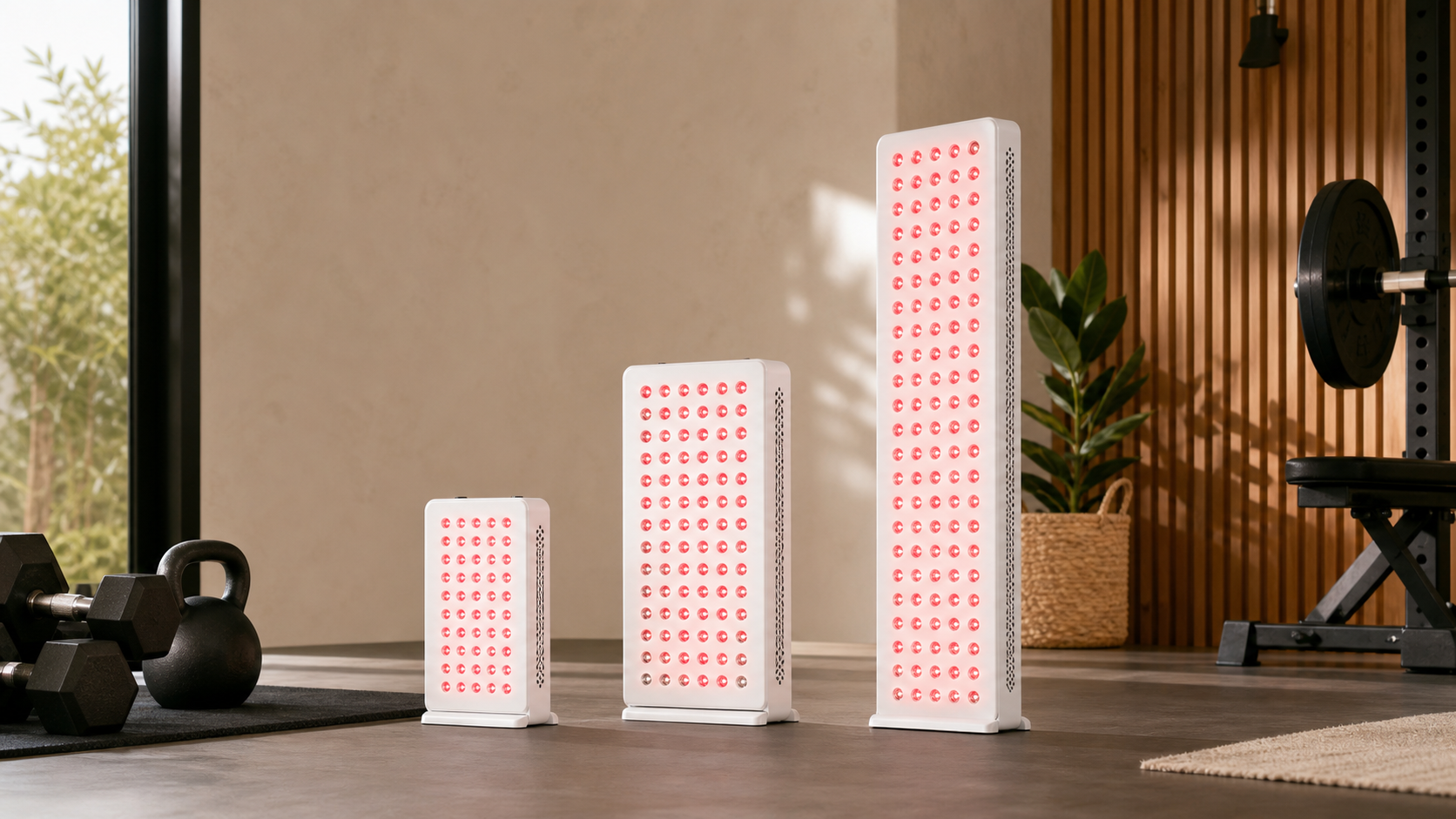
Start with the area you realistically want to expose. A compact panel is easier to place near the face, shoulder, knee, or desk. A medium panel reduces repositioning for the torso or one side of the body. A taller panel can cover more area in one position but requires more floor or wall space and usually costs more.
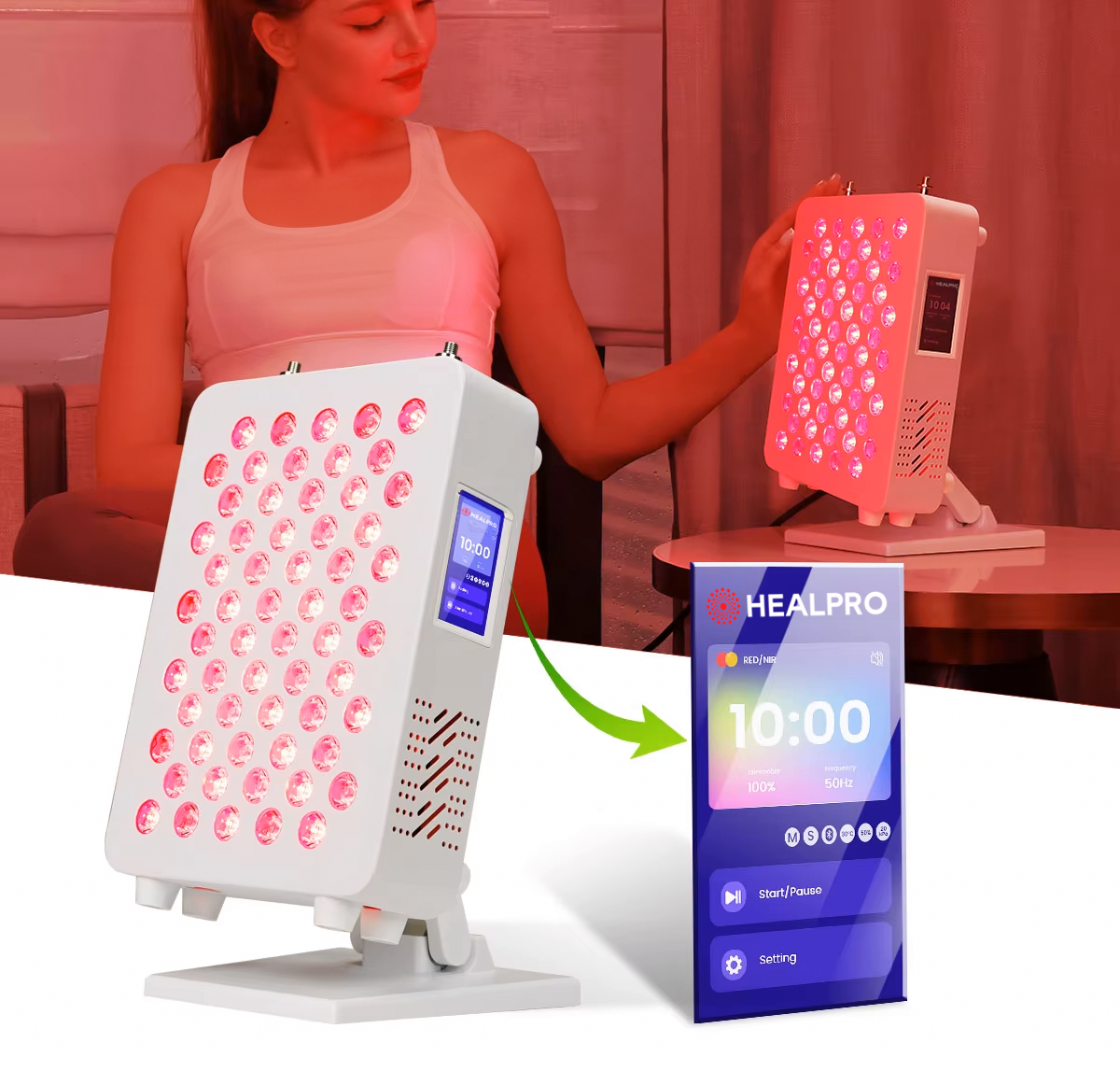
Within the HealPRO range, the Focus is positioned for targeted coverage, the Core for larger or half-body coverage, and the Aura for the largest single-panel coverage. Confirm the current dimensions and included mounting accessories on each product page before publication.
Step 2: understand wavelength without treating it as a magic number
Human trials have used many wavelength combinations. Skin-rejuvenation trials have used 633 nm red light, 830 nm near-infrared light, 660 nm red light, and 590 nm amber light. Hair-growth trials commonly use red light near 655 nm. Sports studies often combine red and near-infrared channels.
Red wavelengths in the low-to-mid 600 nm range are commonly used for superficial targets. Near-infrared wavelengths in roughly the 800–850 nm range are often selected when researchers want more transmission through tissue. But “deeper” does not mean that full panel output reaches deep organs. Direct measurements show that light is rapidly attenuated by tissue, and transmission varies with thickness, anatomy, irradiance, and other physical factors.[2][3]
More wavelengths are not automatically better. A product should disclose how much power each wavelength channel contributes and whether all channels operate together or can be selected separately.
Step 3: distinguish irradiance from dose
Irradiance is optical power arriving per unit area, commonly expressed in milliwatts per square centimetre (mW/cm²). Fluence, or energy density, is the accumulated optical energy per unit area, commonly expressed in joules per square centimetre (J/cm²).
The simplified relationship is:
Fluence (J/cm²) = irradiance (mW/cm²) × time (seconds) ÷ 1,000.
Example: if the measured irradiance at your skin is 30 mW/cm² and the session lasts 600 seconds, the nominal surface fluence is 18 J/cm². This is a mathematical estimate, not a guarantee of how much energy reaches a particular tissue.
Step 4: insist on a stated measurement distance
An irradiance value without a distance is incomplete. Light spreads and intensity changes as you move away from a panel. Beam angle, reflector design, LED spacing, lens geometry, panel size, and overlap between LEDs all affect the pattern.
A useful test report should state:
- the instrument and calibration date;
- the panel mode and brightness setting;
- the distance from panel to sensor;
- whether the value is a centre reading, maximum, minimum, or grid average;
- the warm-up period;
- the number and placement of measurement points;
- ambient conditions;
- the tested product revision or serial number.
A grid average is generally more informative than a single centre peak because the user exposes an area, not one sensor point.
Step 5: do not assume that more dose is always better
Primary cell studies have repeatedly observed biphasic dose responses: lower doses can stimulate a response while larger doses can produce less benefit or an opposite effect. Human fibroblast experiments using 660 nm light found increased mitochondrial activity and viability at lower tested doses and reduced activity at higher doses.[4] Human adipose-derived stem cells also showed wavelength-specific biphasic responses.[5]
Cell culture is not the same as a human treatment protocol, but it is sufficient to reject the simplistic idea that the most powerful panel or longest session must always be superior.
Step 6: compare coverage uniformity, not only panel dimensions
Two panels with the same external size can produce different usable fields. Look for an irradiance map at the intended distance. A good map shows the centre, edges, corners, minimum, maximum, and average. A panel with moderate but even output may be easier to dose consistently than one with a very bright centre and weak edges.
Step 7: decide whether a panel, mask, wrap, or handheld device fits the job
| Form factor | Typical strength | Typical limitation |
|---|---|---|
| Panel | Flexible positioning and larger exposed area | Distance must be controlled; may require repositioning |
| Face mask | Fixed geometry around the face and hands-free use | Face-specific; comfort and fit vary |
| Wrap or pad | Close contact around a defined area | Smaller coverage and heat/fit considerations |
| Handheld | Precise positioning for small areas | Time-consuming for large areas |
There is no universal best form factor. The relevant question is whether the device can deliver a documented protocol to the area you intend to expose.
Step 8: inspect usability and repeatability
A technically capable device has little value if it is difficult to use consistently. Compare:
- timer accuracy and automatic shut-off;
- brightness controls;
- red-only, near-infrared-only, and combined modes;
- stand, door, wall, or tabletop options;
- panel weight and stability;
- remote or grouped control;
- noise and heat;
- clear user instructions;
- service, parts, returns, and warranty support.
Step 9: evaluate safety information
Look for a product-specific manual with eye guidance, photosensitivity warnings, contraindications, electrical instructions, cleaning requirements, and a clear process for reporting a fault or adverse event. Controlled human safety trials show that red light can be tolerated at substantial doses, but very high fluences can still cause skin reactions in some participants.[6]
Step 10: use this purchase checklist
- What exact area can the panel cover at the recommended distance?
- Which wavelengths are standard, and which are optional?
- Can the red and near-infrared channels be controlled separately?
- What is the grid-average irradiance at 15 cm and 30 cm?
- What instrument was used?
- Is there a downloadable test report?
- What are the panel-only and stand-installed dimensions?
- What accessories are included?
- What does the warranty actually cover?
- Where is repair and customer support located?
- Are the product page, manual, schema, and feed specifications consistent?
Bottom line
The best panel is not necessarily the one with the highest advertised power, the largest number of LEDs, or the longest wavelength list. The better choice is the panel whose coverage fits your routine and whose measurements are transparent, reproducible, and matched to a clearly explained use protocol.
Use the HealPRO panel comparison and read how HealPRO measures panel output before selecting a model.
Frequently asked questions
What irradiance should a red light panel have?
There is no universal ideal number. The useful value is the measured output at your intended distance, combined with the session time and target dose. A centre maximum is less informative than a uniformity map and average.
Are five wavelengths better than two?
Not automatically. Additional wavelengths only help if they are present at useful output and relevant to the intended protocol. The strongest evidence often comes from defined one- or two-wavelength studies.
Is near-infrared always better because it penetrates deeper?
No. The target matters. Near-infrared can transmit differently through tissue, but red light may be more relevant for superficial targets. Both are strongly attenuated by tissue.
Should I buy a panel or a face mask?
Choose a mask for fixed facial geometry and hands-free convenience. Choose a panel for flexible positioning and larger coverage. Compare actual dose, distance, comfort, and intended use.
References
- GummySearch. r/redlighttherapy community analysis. Accessed 19 July 2026.
- Depth of penetration of an 850 nm wavelength low-level laser in human skin. Photomed Laser Surg. 2007.
- Sex, but not skin tone, affects penetration of 660 nm red light through human tissues susceptible to sports injury. J Biophotonics. 2019.
- Biphasic Dose/Response of Photobiomodulation Therapy on Culture of Human Fibroblasts. Photobiomodul Photomed Laser Surg. 2020.
- Photobiomodulation of human adipose-derived stem cells using 810 nm and 980 nm lasers operates via different mechanisms. 2016.
- Jagdeo J, et al. Safety of light emitting diode-red light on human skin: two randomized controlled trials. J Biophotonics. 2020.
How this article was prepared
The question was selected from recurring discussion clusters in r/redlighttherapy. Reddit discussions were used to identify what people want answered, not as proof of effectiveness. Scientific conclusions were based on the cited human trials and supporting primary research. Commercial links are separated from the evidence discussion.